baby language and cognitive development: parent-child interaction in baby carrier

During the infant and toddler development stage, the development of language and cognitive skills is a major concern for many parents . Recent research has shown that baby carriers not only facilitate travel and care for babies, but can also be effective tools for promoting language and cognitive development. Through close interaction, babies can be exposed to language stimulation and perceive the world around them in a safe environment, accelerating cognitive development.
The importance of carrier interaction for language development
Babies are born with a keen sense of sound, particularly their parents’ voices and intonations. Studies have shown that close interaction with parents helps babies understand language more quickly and fosters early expressive skills. When using a baby carrier , babies are perfectly positioned to clearly hear their parents’ conversations and observe their expressions.
In everyday life, you can naturally promote your baby’s language development through small, everyday activities. For example, while taking a walk or at home, casually describe the surroundings: “Look, that’s a yellow flower, so beautiful.” Babies learn language through the combination of hearing and vision. You can also direct your baby’s attention with simple questions: “What’s that sound? It’s a bird singing.” When your baby babbles, gently imitate and respond with simple words. This allows your baby to experience the joy of communication and practice the rhythm and rhyme of language.
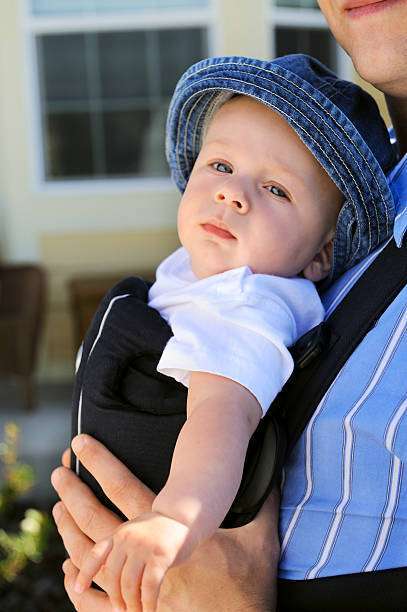
Cognitive Development and Interaction in the Carrier
Babies’ cognitive development requires multi-sensory stimulation. A baby carrier allows them to observe their parents’ movements, feel their heartbeat, and listen to the sounds of the environment, while simultaneously developing their attention, understanding of cause and effect, and spatial perception.
In practice, you can let your baby explore and learn naturally in a carrier through daily activities. When I ‘m doing chores or tidying up toys at home, I’ll have my baby observe my movements and describe them verbally: “Mommy is wiping the table.” This way, the baby can connect the words to the actions. When walking or gently rocking your baby, you can hum softly or clap along to let your baby experience rhythm and develop coordination. Alternatively, let your baby gently touch clothing or toys of different materials and describe the feel: “Soft, plush toys!” This allows your baby to experience the world through hearing, touch, and vision.
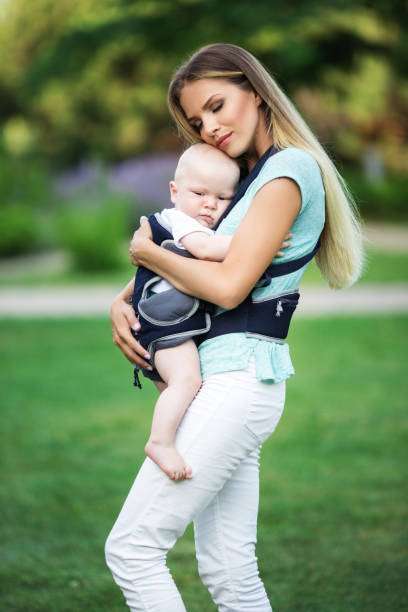
Psychological benefits for parents
Parent-child interaction in a baby carrier not only benefits the baby but also improves the parents’ psychological well-being. Close interaction with the baby can help alleviate parenting anxiety, strengthen emotional connection with the baby, and boost parenting confidence. Psychological research shows that close, regular interaction can lead to more positive parenting experiences and increase sensitivity to the baby’s needs.
Safety and Precautions
Correct wear : Make sure the carrier supports your baby’s spine and hip joints and is ergonomically designed.
Interactive Safety : When out and about or doing chores, pay attention to your surroundings to avoid distractions that could cause accidents.
Time control : Avoid keeping the baby in a fixed position for a long time. You can adjust the baby’s direction or let him rest appropriately.
Summarize
The baby carrier is not only a convenient parenting tool, but also an interactive way to promote language and cognitive development. Through eye contact, verbal descriptions, and rhythmic interaction, babies can receive multi-sensory stimulation in a safe and close environment, while parents can also enhance their parenting confidence through interaction.