Holding a baby shouldn’t be a “weight training” exercise: A scientific way to make it easier with a baby carrier

When it comes to taking your baby out, a baby carrier is practically a lifesaver for new parents. It frees your hands, allowing you to shop, stroll, or travel—but many parents struggle with the same issues: shoulder strain and back pain after carrying their baby for extended periods.
Sometimes it’s not the sling itself that’s “wrong,” but rather the incorrect posture and choice of carrier. Today, let’s discuss how to carry your baby properly, making your body more relaxed and your parent-child time more comfortable.
1. The root cause of pain: incorrect posture, and the strap will hurt your waist
Many parents tend to hang their baby too low or too far forward when they first start using a baby carrier. This will shift the baby’s center of gravity forward, forcing the lumbar spine to support the entire weight, which can cause pain over time.
Another common problem is improperly adjusted shoulder straps. If they’re too loose, you’ll tend to lean forward, while if they’re too tight, they’ll compress your shoulders and neck. Plus, if your waist isn’t properly supported, it can feel like you’re “bending over a heavy load.”
Tips:
1. Place the baby’s head approximately level with the chin; the ideal height is “kissable on the forehead”;
2. The waist belt should fit snugly against the hip bones to bear weight, rather than squeezing the waist;
3. The shoulder straps should be adjusted to evenly distribute the weight without squeezing the shoulders or shaking.
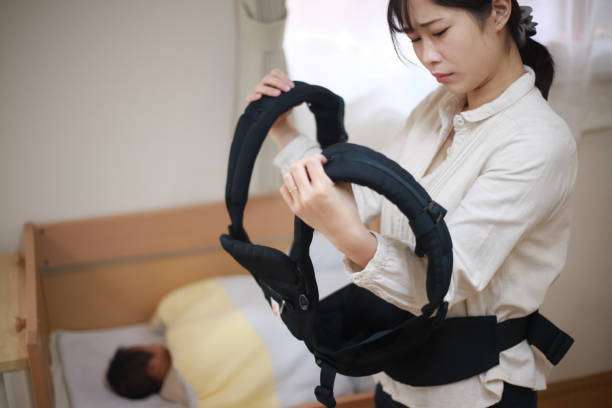
2. Ergonomic design that makes both the body and the baby comfortable
A properly fitted sling can significantly reduce pressure on the body. The ergonomic design allows the baby to maintain a natural “M-shaped legs, C-shaped back” posture, which not only helps with hip development but also helps parents maintain a more stable center of gravity without the need for extra support.
I used to use a regular shoulder strap, but it often felt tight in my shoulders after just a dozen minutes. I later switched to a design with a padded waist pad and adjustable shoulder straps, which distributed the weight more evenly and made my back feel much easier.
Selection points :
1. The material should be breathable and supportive;
2. The shoulder straps and waist belt should be wide enough;
3. It is best to adjust according to the baby’s age and the parents’ body shape.
These details often determine the difference in comfort.
3. Parents’ posture is equally important: a strong core makes carrying the baby more stable
No matter how good the baby carrier is, it still needs a “stable support point” – that is the parent’s own body.
If you hunch your back, hunch your chest, or tilt your pelvis forward, the pressure on your back will be doubled.
It is recommended that parents do some light training:
Plank : Enhance core stability;
Glute Bridge : Strengthens the hips and lower back;
Cat-Cow : Improves spinal flexibility.
Tip : When carrying your baby, stand upright, tuck in your stomach, and relax your shoulders. Your posture will be stable, and your baby will feel more secure.

4. Determine whether the strap is really suitable
You may need to recheck or replace your harness if you experience any of the following:
After just a few minutes of back support, my shoulders feel tight and my waist becomes sore.
The straps tend to slip or need constant readjustment
The baby is always “hung” in a very low position
Adjusting the shoulder straps, securing the waist, and raising the baby’s position usually provide immediate relief. If discomfort persists, consider switching to a more supportive design.
5. From “Backache Mom” to “Easy Walker”: My Personal Transformation
During the first few weeks of using the baby carrier, I massaged my lower back almost daily. I later realized the problem wasn’t “carrying” the baby, but “how to carry it.”
Once I learned the correct posture and found the right baby carrier, I could easily carry my baby for two hours without getting tired.
That sense of relief wasn’t just physical, it was also psychological. With my baby sleeping soundly on my chest, I could feel their comforting weight, and it felt like the world had slowed down.
Conclusion
Carrying a baby should be a gentle and natural experience, not a physical challenge.
With the right technique, a well-fitting baby carrier , and a little daily exercise, parenting can become easier and more enjoyable. Carrying a baby doesn’t have to be arduous; a scientific approach can help your love last longer. Start now and enjoy a more relaxed and intimate time with your baby.