Weight changes and support pressure: the key balance point for baby carrier comfort

In the first few months of raising a child, the baby carrier is practically every parent’s “third hand.” But as the baby’s birth weight gradually increases from three or four kilograms to eight or ten kilograms or even more, the once easy experience of carrying them can become arduous. Whether the carrier remains comfortable not only affects the parent’s shoulder and back burden but also impacts the baby’s physical development and safety. Maintaining this “comfortable balance” hinges on understanding the relationship between weight changes and support pressure.
I. Changes in weight mark the beginning of structural challenges.
A baby’s weight gain is not linear. It typically grows fastest in the first six months, increasing by 600 to 800 grams per month. After six months, the growth rate slows, but the overall weight is more than double that of a newborn. This weight change puts greater downward and torsional forces on the baby carrier’s structure. If the carrier’s support points are poorly designed, concentrating the weight on a single point can easily lead to neck and shoulder compression, lower back strain, and even compensatory bending of the parent’s posture.
For babies, increased weight also means greater demands for swaddling and support. Newborns require head and neck support, while after six months, they need more stable support for their hips and thighs. If baby carriers continue to use the early “sack-like” structure, it can easily cause the baby’s center of gravity to shift forward, putting pressure on their spine.
II. The core of comfort: support distribution rather than thickness
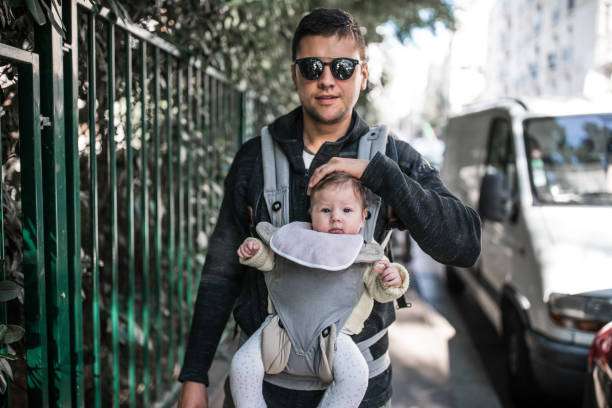
Many parents mistakenly believe that “thicker padding” will improve comfort, but in reality, the key to comfort lies in the distribution of support. An ideal baby carrier should allow the baby’s weight to be evenly distributed along the shoulder straps, waist belt, and back support surface. The shoulders are responsible for lifting the upper body, the waist supports the main weight, and the tension of the back fabric stabilizes the baby’s posture.
As a baby gains weight, their center of gravity shifts lower. If the waistband isn’t wide enough or doesn’t provide sufficient coverage, it will create a concentrated pressure point, making parents feel constricted or that the baby is sagging. A good baby carrier uses an “X-shaped” or “wide waistband” design to distribute the force across a wider area, reducing downward torque and pressure on the shoulders and neck. At the same time, for the baby, this even support helps maintain the natural C-shape of the spine, reducing outward strain on the hips.
III. Dynamic Factors of Comfort: Body Temperature and Material Feedback
Comfort isn’t just about less pressure in a mechanical sense; it also includes the experience of heat and touch. As babies gain weight and become more active, their body heat dissipates more quickly. If the carrier material isn’t breathable enough, it can lead to a buildup of moisture and heat between the parent and baby, increasing skin friction. In this case, polyester-cotton blends or mesh carriers are better at keeping the baby dry than pure cotton.
At the same time, the elastic fabric of the baby carrier needs to be re-evaluated. Initially, a soft, elastic carrier can fit the newborn’s body well, but as the baby grows heavier, excessive elasticity can cause the center of gravity to shift, creating a “suspension” feeling. In this case, a more supportive, low-stretch fabric or structural carrier should be chosen to maintain a proper fit.
IV. Carrier Adjustment and Parent Posture: An Extension of Human-Machine Relationship
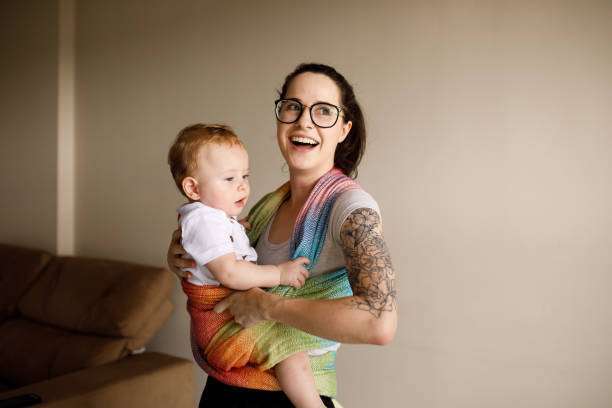
A baby carrier depends not only on the product itself but also on the user’s posture. As the baby gains weight, maintaining the same shoulder strap length or carrying angle can cause the body to passively lean forward, resulting in a tired, arched back. The correct approach is to readjust the shoulder straps and waist belt before each use, ensuring the baby’s head is at kissable height and their back is against the parent’s chest and abdomen.
Furthermore, weight gain means that usage time should be replanned. After each continuous carrying session exceeding one hour, there should be a 10-15 minute rest and stretching period to restore blood flow to the spine and shoulder muscles. In the long run, this fine-tuning and intermittent use can significantly reduce the risk of back pain and muscle tightness.
V. Finding a “synchronized rhythm” for growth and support
A baby carrier is actually a dynamic balance: the baby’s growth rate changes, and the parent’s physical endurance also changes. Ideally, the design and adjustment of the carrier should keep pace with this growth. Choosing a carrier with multi-level support and adjustable shoulder width and waist length allows for a comfortable experience across different weight stages.
When parents understand the underlying logic of weight gain and the pressure it provides, the baby carrier is no longer just a “tool,” but a vessel that accompanies growth. It reminds us that comfort is never fixed but rather a continuous process of being rebuilt through understanding, adjustment, and co-adaptation.