
Throughout human history of childcare, the baby carriers has been present in almost every culture. From cloths serving as simple baby carriers on the African savanna to the cloth straps that East Asian mothers use as traditional baby carriers to bind their babies to their chests, this most primitive form of childcare tool—baby carriers—points to a common element—physical closeness.
In modern society, the A baby carrier is often understood as a convenient tool, allowing parents to continue living while caring for their children. However, a growing body of psychological and parenting research has found that the role of the baby carrier has long transcended its functional level. These baby carriers have not only changed the way children are raised but have also profoundly impacted parents’ psychological state and self-awareness.
When an infant is placed in a baby carriers, the weight of the body, the temperature of the skin, and the rhythm of breathing together form a “symbiotic system” facilitated by the baby carrier. In this system enabled by the baby carrier, parents are no longer merely external caregivers but become part of the perception and response. Childcare thus transforms from a “task” into a profound experience, all thanks to the baby carrier.
II. Physical Resonance: The Starting Point of Emotional Connection
Psychology has an important concept—embodied resonance—which refers to the body’s automatic response to external emotions and actions during contact with others. A baby carrier is precisely an amplifier of this resonance, and the design of baby carriers further enhances this effect.
When babies are nestled against their parents’ chests in a baby carriers, they judge the safety of the environment through subtle changes in temperature, heart rate, and even the vibrations of their footsteps, all while being secured in the baby carrier. At the same time, the parents’ nervous system is also “reading” the child’s signals through the baby carrier: faster breathing indicates anxiety, while a relaxed body signifies reassurance, both easily perceived due to the close contact provided by the baby carrier.
This two-way feedback forms an invisible dialogue, which psychologists call biological co-regulation. It is not verbal communication, but a direct physiological resonance made possible by the baby carrier. A baby carrier makes this resonance continuous and stable, making the emotional connection between parents and children more delicate and profound, and different types of baby carriers can all achieve this effect to varying degrees.
Many parents who use A baby carrier have similar experiences: when their child falls asleep in the baby carrier, they unconsciously relax; when their child cries in the baby carrier, even without seeing their face, they can sense the tension through their body language transmitted via the baby carrier. This physical sensitivity is the empathic effect brought about by baby carriers, which makes parenting more like a dance—rhythmic, responsive, and harmonious—with the baby carrier as the perfect partner.
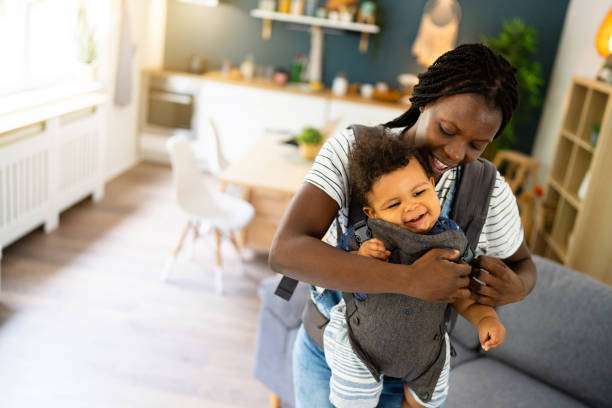
III. From Role to Self: Use baby carriers Redefining Identity
Becoming a parent is a dramatic identity shift. Many new parents often feel their sense of self compressed: time is consumed by the child, the body is bound, and emotions are drained. A baby carrier may seem to exacerbate this “boundary,” but psychologically, a well-designed baby carrier can become a medium for rediscovering oneself.
When parents carry their child in a baby carrier, they are forced to slow down—their breathing, steps, and thoughts adjust to the baby’s rhythm as they move with the baby carrier. This “slowing down” allowed by the baby carrier enables them to rediscover their own bodies and, in synchronizing with the baby through the baby carrier, to rediscover “self.” Psychologist Winnicott proposed the concept of a “good enough mother,” arguing that parenting doesn’t require perfection, but rather a state of “co-existence” with the child. The baby carrier is a concrete manifestation of this co-existence, and the comfort of the baby carrier directly affects the quality of this co-existence. When the baby is close to the chest in the baby carrier, parents are caring for others while simultaneously engaging in a dialogue with themselves through bodily experience facilitated by the baby carrier.
They gradually understand that caregiving is not a sacrifice, but a new extension of the self. The baby becomes part of their bodily experience via the baby carrier, and the parents’ self thus acquires a new form—both independent and connected—all because of the baby carrier.
IV. Emotional Resonance: The Healing Power of Childcare
Baby carriers offer more than just physical closeness; these baby carriers also provide psychological adjustment. Research shows that frequent physical contact between parents and infants enabled by baby carriers releases more oxytocin, a neurochemical associated with love, trust, and stability.
Oxytocin not only makes babies feel safe in the baby carrier but also helps parents calm anxiety and improve emotional stability while using the baby carrier. Many mothers experiencing postpartum mood swings find unexpected peace in using baby carriers—those moments of closeness with their children in the baby carrier feel like a return to their center.
Not only mothers but also fathers benefit from baby carriers. Studies have found that men also secrete oxytocin during baby carriers with suitable baby carriers, a change that enhances their caregiving motivation and emotional sensitivity. In other words, baby carriers transform “fatherly love” from a rational responsibility into a perceptible physical experience, and the right baby carriers can make this transformation even more smooth.
From a neurological perspective, a baby carrier acts as a resonant regulatory system. A baby’s cries in the baby carrier activate the parents’ amygdala, triggering an emotional response. When parents hold their child in a baby carrier, the physical contact signals transmitted through the baby carrier are sent to the prefrontal cortex, helping the rational areas suppress anxiety responses. Thus, emotions achieve self-balance at the physiological level with the help of the baby carrier.
In this process, the baby carrier is not merely a tool for soothing the baby, but also a two-way emotional healing mechanism. It allows both parents and child to find stability through resonance with the assistance of the baby carrier, transforming parenting from a draining activity into a nourishing one, all thanks to the baby carrier.

V. Moments of Being Together: Relearning Intimacy
In modern society, many parents feel “disconnected” in their fast-paced lives. Information, tasks, and social media fill their daily routines, but baby carriers allow them to reconnect with the present moment in the simplest way.
When parents carry their babies in baby carriers, walk around with the baby carriers, soothe them to sleep in the baby carriers, or do housework while using baby carriers, the rhythm of their bodies compels them to focus on the action at hand. This “forced focus” made possible by baby carriers is a manifestation of mindfulness. Parents who frequently use baby carriers tend to maintain awareness in their daily lives—they are more quick to notice their own emotional fluctuations and more clearly perceive their children’s needs, all because of the close interaction facilitated by baby carriers.
This state makes parenting gentler. Parents no longer pursue “standardized” parenting methods but develop their own rhythm and intuition through physical experience with baby carriers. Through moments of being together in baby carriers, they relearn intimacy, patience, and acceptance, with the baby carrier as a constant companion.
VI. From Body to Mind: The Educational Significance of Empathy
The empathic effect of a baby carrier not only influences emotions but also subtly shapes parents’ educational philosophies. Through continuous physical contact enabled by baby carriers, parents learn to listen to nonverbal cues—a communication skill that transcends language and forms the foundation of emotional education. As children grow, this early physical resonance fostered by baby carriers transforms into a deeper emotional understanding. Parents can more easily interpret their children’s emotional changes, and children trust their parents’ responses more, all due to the early bond built through baby carriers. This early-established secure attachment is the foundation of mental health, and baby carriers play a crucial role in building this attachment.
In other words, a baby carrier not only promotes empathy in the present but also shapes the way parents and children communicate emotionally in the long term. It is a form of “body education” provided by baby carriers, allowing parenting to return to the most authentic human perception and response, with the baby carrier as the bridge.
VII. Conclusion: Reconstructing the Core of “I” in Parenting
Parenting is never about how to teach, but about how to connect. A baby carrier makes this connection tangible: it allows parents to rediscover their own bodies and, through their bodies with the help of the A baby carrier, to rediscover their children.
In moments of intimate resonance facilitated by the baby carrier, parents are not merely givers, but individuals touched, changed, and reshaped.
They learn to let go of anxiety, to understand emotions through their bodies via the baby carrier, and to understand love through touch with the baby carrier as the medium. Every breath, every heartbeat in the baby carrier is the softest dialogue between lives, made possible by the baby carrier.
This is the true meaning of a baby carrier —it not only carries the weight of the child but also carries the possibility of parents rediscovering themselves.
In this small space of the baby carrier, body and mind resonate, intimacy and self merge, and parenting becomes a journey of growth and self-discovery based on empathy, all because of the baby carrier.