The Hidden Power of Baby Carrier: 3 Psychological Impacts that Reshape Parents’ Sense of Time

I. When Time No Longer Belongs to Us: Psychological Dislocation in Parenting
When using a baby carrier, parents regain their freedom of movement—they can move around, do housework, read, and even go for a walk. Although the child is still on their back, time seems to begin to pass again. The baby carrier becomes a subtle psychological turning point, allowing parents to find a new way to balance childcare and self-care.
Becoming a parent suddenly changes the way time flows. In the past, we were always focused on planning, and time was clearly divided and controllable—eight hours of work, one hour for lunch, two hours for entertainment, and seven hours for sleep. But when a baby comes into our lives, everything becomes unpredictable. Children have no concept of day and night, nor do they understand what a “schedule” is. Their cries, hunger, sleepiness, and laughter become the new scale of time.
In psychology, this experience is called “a sense of loss of time sovereignty.” Parents go from being proactive time controllers to passive caregivers. You’ll find your rhythm completely disrupted: you’re just about to take a sip of water when the baby cries; you’re just about to reply to a message when the baby needs a diaper change. Every trivial moment squeezes out your “self.” Time no longer seems to belong to you but is ruled by the baby’s rhythm.
This psychological dislocation can easily lead to anxiety and exhaustion. Parents often feel exhausted at the end of the day, yet can’t quite articulate what they’ve accomplished. This is because, during childcare time, “completing tasks” is no longer the standard for measuring the day, but rather “how many chaotic moments have passed.” However, it is precisely within this disordered sense of time that the baby carrier emerges. It is not only a tool to free up hands but also a psychological balancing device.
II. The First Psychological Impact: Forced Synchronization and “Mindfulness Moments”
The most significant psychological impact of baby carrier is the “forced synchronization.” When carrying a child, your body must follow their rhythm—you can’t walk too fast, you can’t stop suddenly, and even your breathing is unconsciously adjusted. This synchronization can be uncomfortable at first: you are forced to slow down, forced into a gentle, slow-paced lifestyle.
But as you gradually adapt, you’ll find it’s a profound psychological experience. Psychologists call this phenomenon co-regulation, where parents and infants mutually regulate their emotions through physical contact and breathing rhythms. When the child calms down in the carrier, the parents’ heart rate also slows down; when the parents are at peace, the child’s crying is easier to soothe.
This two-way bodily rhythm brings about a new “awareness of time.” In that moment, time no longer progresses linearly but becomes rounded and soft. You begin to live in the present moment—not because of deliberate mindfulness practice, but because your child makes it impossible for you to escape “this moment.” Every step you take, every breath you take, even the touch of the wind on your face, becomes exceptionally clear.
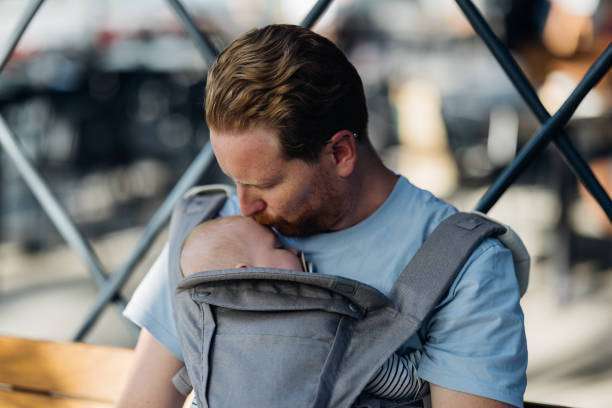
Many parents have described this experience: their child falls asleep in the baby carrier, their breath gently against their chest, their body warmth transmitted through the fabric. At that moment, the noise of the outside world seems to disappear. Time becomes tangible, perceptible, and slows down. It’s a psychological balance and also an emotional healing. The baby carrier forces people to slow down, yet it also allows them to rediscover the meaning of “being present.”
Third, the second psychological impact: the boundary between intimacy and self.
Baby carrier come from “excessive intimacy.” In research on intimate relationships, excessive physical proximity can sometimes blur an individual’s personal boundaries. Baby carriers allow parents and infants to be almost seamlessly together, with skin separated by only a layer of fabric, and their breaths and heartbeats nearly overlapping. Such closeness brings a sense of security, but it can also bring a psychological pressure of “being constantly needed.”
For mothers, this feeling is particularly complex. They experience both the sweetness of their child’s attachment and the burden of being constantly controlled. Their bodies, attention, and emotions are tightly bound to their child, and they may even subconsciously “hear” the child crying when the child is not around. In psychology, this phenomenon is called “empathic overload,” a type of emotional exhaustion commonly seen in long-term caregiving.
The baby carrier at this moment is two-sided: on the one hand, it strengthens the attachment between mother and child, giving the child a psychological foundation of security; on the other hand, it also makes the mother feel the dissolution of her identity—”I” no longer seem to be an independent individual but just a continuous caregiver.
For fathers, this intimacy represents a sense of connection. In the past, fathers were often seen as observers or facilitators, lacking direct contact with their infants. Baby carriers allow fathers to participate in childcare “physically” for the first time. When the child is against their chest, fathers experience an unprecedented sense of responsibility and connection. Research shows that fathers who frequently use baby carriers are more likely to establish early emotional resonance; their brains’ emotional centers respond more strongly when faced with their child’s cries or smiles.
Therefore, baby carriers are not only a physical tool but also a psychological channel. They make people rethink the meaning of “intimacy”—intimacy is not about losing oneself but about finding a new balance in sharing life.

Fourth, the third psychological impact: Time is redefined.
In the rhythm of baby carriers, the meaning of time is completely rewritten. In modern society, time is centered on efficiency, emphasizing planning and results. But when parents carry their babies, lull them to sleep, and sing softly, time is no longer linked to “production” but becomes an experience in itself.
In psychology, there’s a concept called embodied time, which refers to how people perceive time through their bodily states. For parents carrying their children, their sense of time is reshaped by their bodies—the rhythm of their footsteps, the frequency of their breathing, and the sound of their child’s breathing create a new timekeeping system. Ten minutes is no longer about waiting or anxiety but about sharing ten minutes with their child.
This experience of “slow time” has a profound impact on mental health. When parents let go of the “must-do” mentality and begin to accept “just being there,” the brain’s stress system gradually relaxes. Cortisol levels decrease, heart rate stabilizes, and the person enters a state of “gentle flow.” This state is considered a natural healing mechanism in psychology.
Baby carriers allow parents to rediscover the depth of time while caring for their children. Time is no longer a series of fragmented seconds but a long river connected by body temperature and emotions. In this flow, parents rediscover the meaning of “existence”: the value of life lies not only in efficiency and goals but also in those moments of slowing down and being filled with tenderness.
V. Psychological Reflections of Society and Culture
Baby carriers also reflect a psychological need in contemporary society. Modern urban families are generally smaller, and parents lack support systems in childcare, easily falling into isolation and anxiety. Baby carriers become a way to connect psychologically—allowing parents to re-enter society and life with their children.
Mothers can carry their children to the supermarket, for walks, or to meet friends; fathers can carry their children to the park, for coffee, or to participate in family activities. This scenario is not just about convenience but also a psychological symbol: parenting no longer means self-isolation but rather a portable lifestyle.
Psychologists believe that this “living with a child” model helps rebuild parents’ self-identity. It weakens the concept of “self-sacrifice” and transforms parenting from a responsibility into a symbiotic process. In the rhythm of childcare, people learn how to find a balance between love and freedom.
VI. Conclusion
The baby carrier is a highly symbolic item. It connects the bodies of parents and children and also the two ends of a fast-paced society and a slow-paced life. It allows people to rediscover the weight of their breath, the rhythm of their steps, and the reality of the present moment.
From a psychological perspective, the triple impact of the baby carrier—forced synchronization, reconstruction of intimacy, and redefinition of time—is precisely the psychological process of parenthood formation. It transforms parents from “controllers” to “companions,” from “people chasing time” to “people dancing with time.”
As the child sleeps peacefully in the baby carrier, the parents’ hearts find peace. At that moment, time is no longer a linear schedule but a circular cycle—you hold your child, and time holds you. In this gentle rhythm, parents rediscover themselves and re-understand the meaning of “the present moment.”