
A proper fit isn’t just about “putting it on and it’s fine”; it’s the first and foremost safety requirement.
Most parents intuitively believe that as long as they put on a baby carrier, fasten it, and make it tight, their baby will be safely supported. However, when we further observe the meticulous requirements for fit from spinal development experts, orthopedic surgeons, and baby carrier engineers, we find that the so-called “suitable” baby carrier is actually far more complex than what is superficially perceived as tight or loose.
Fit not only determines whether the natural curves of the baby’s spine and pelvis are maintained, but it also directly affects the degree to which the newborn’s airway opens, whether body pressure is concentrated, and whether the burden on the parents increases exponentially. Many parents think that whether a baby carrier is easy or not depends on the material of the shoulder straps or the size of the seat, but in fact, fit itself is the decisive variable.
This article will delve into the underlying structural logic of a proper fit, from the design principles of baby carrier, baby spinal development, and changes in support during dynamic movements to how parents of different body types can adjust the fit differently.
The goal is to help readers not only know that a fit is necessary but also to truly understand why and how a fit is important and even to be able to visually judge whether the carrier is in its ideal state during daily use.
Before understanding fit: Understanding the evolution of a baby’s natural spinal curve
If the baby carrier doesn’t fit properly, the most direct impact will be on the baby’s spinal curvature, especially the development of the C-shaped spine to the S-shaped spine in newborns, which is very sensitive.
In the first few months after birth, a baby’s neck strength is insufficient and their back muscles are not yet fully developed, so any external force or deformation will put unnecessary pressure on the spine. If the baby carrier is too hard, the backrest is too straight, or the seat angle is incorrect, the baby’s back cannot bend along its natural curve, and this pressure will accumulate during prolonged carrying.
The true goal of a snug fit is not to “press” the baby “tightly,” but to allow the backrest, lining, and hip seat structure to mimic the baby’s natural, relaxed spinal position. Understanding this clarifies why overly stiff fabrics, overly soft support, and excessively high footrests can cause unnecessary twisting of the baby’s spine.
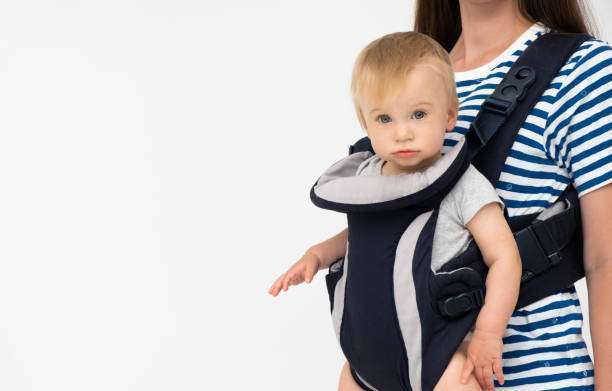
A baby carrier’s fit: stability, not tightness.
Many parents mistakenly believe that with a snug fit, “the tighter, the better.” However, tightness does not equate to stability; true stability comes from a balanced distribution of support.
A baby carrier needs to create continuous contact with the baby’s body, but this contact should be a gentle, supportive embrace, not a source of pressure. For example, if the carrier straps are too loose, the baby’s center of gravity will drop, causing strain on the spine; but if they are too tight, the baby’s chest will be compressed, affecting their breathing rhythm.
An ideal fit provides “overall support,” ensuring that the baby’s back, hips, thighs, and even the backs of the knees are all on a structurally supported surface. Any fit that only provides partial support or has broken support points can easily cause the baby’s body to be in a twisted position, and parents will also feel increasingly tired carrying the baby due to the shifted center of gravity.
Fabric, back panel, and support structure: the engineering design behind fit
The differences in fit between baby carriers on the market are often not due to parental experience but rather determined by the structural design itself.
For example, different brands’ choices of backrest firmness directly affect the fit. Soft backrests fit more snugly but are less likely to maintain structure; hard backrests are more stable but can easily force the baby’s back into deformity. The optimal solution is a combination of “structurally stable and soft to the touch,” where the internal structure provides support, while the surface layer is responsible for softness and skin-friendliness.
The width of the seat and the angle of the thigh support also affect the fit. If the seat is too narrow, there is insufficient thigh support, causing the baby to sag and putting pressure on their back; if it is too wide, it can easily pull the hip joints apart, increasing swaying within the baby carrier. Ultimately, the fit is created by the entire carrier system as a whole, not determined by a single part.

Dynamic fit: How does the fit change when the baby or parents move?
Many parents believe that the fit only needs to be adjusted when wearing the baby, but in reality, the fit will subtly change when moving, walking, bending over, or picking up the baby. When the baby falls asleep, their body softens and their leg tension decreases, which will also cause the fit to readjust.
An ideal baby carrier needs to accommodate these dynamic changes without losing stability. High-quality carriers often absorb these changes through waist stability, shoulder support, and a back panel that conforms to the curves, maintaining a consistent fit during movement. This is why some carriers become more comfortable with use, while others become more tiring.
Blind spots caused by differences in parental body size
Parents often overlook the impact of their body shape on the fit of the baby carrier. For example, parents with broad shoulders may create extra space on the sides of the carrier, resulting in an uneven fit; mothers with fuller chests may cause the baby’s chest and abdomen to be pushed extra when holding the baby in a front-facing position; and taller parents may cause the backrest angle to be incorrect, preventing the baby’s back from lying flat.
The solution isn’t to make it “tighter” or “looser,” but rather to restore a proper fit through the adjustment straps and angles of the baby carrier’s structure itself. If parents understand that a proper fit isn’t an absolute value but rather a matter of “the relationship between the body and the carrier” that varies from person to person, they can more easily find the most suitable method for themselves.
Everyday details that affect fit: temperature, clothing, fabric friction, and baby’s condition.
The fit of the baby carrier is affected not only by its structure but also by the environment and the baby’s everyday clothing. When the baby wears thick clothes, the back panel is less likely to fit snugly; the hotter the weather, the more likely the baby will sweat and slip; and when parents wear soft tops, the shoulder straps of the carrier may become loose.
These changes can cause the fit to fluctuate, so parents are advised to make “fit observation” a small habit before each use. For example, check if the baby’s back is naturally curved, if the waist is firmly supported, and if the thighs are in a stable, open position. When these details become routine, the comfort and safety of the baby carrier will naturally improve.
The fit between newborns and older babies is completely different.
Many parents are unaware that babies of different ages require completely different fit structures. Newborns need “full back support,” allowing their bodies to fully conform to the backrest; older babies need more room to stretch and rely on their core strength and the carrier to maintain their posture.
This is why some baby carriers work perfectly in the newborn stage but become heavy for parents after nine months; conversely, some baby carriers are unsuitable after birth but become easier as the baby grows. Understanding the relationship between fit and age allows parents to make more precise adjustments at different stages.

Baby Sleep and Fit: Why Are Risks Higher While the Baby Is Asleep?
When a baby is asleep, their body is completely relaxed, and their spine and joints enter a more passive state. At this time, the fit of the baby carrier is even more important than when they are awake. If the backrest cannot maintain stability while the baby is asleep, the risk of the baby slipping, their head drooping, and airway compression increases dramatically. If parents see their baby sleeping “tilted to one side” in the carrier, it’s usually not because the baby is comfortable, but because the fit hasn’t kept up with the changes in the baby’s body weight during sleep.
Fit is the highest standard for judging the quality of a baby carrier.
More important than the number of features, accessories, appearance, and materials, the fit of a baby carrier is the decisive indicator of its quality. A well-fitting carrier allows parents to remain stable during daily activities, rapid movement, and long outings without accumulating pressure or causing discomfort to the baby. A poorly fitting carrier, no matter how attractive its appearance or how fancy its features, will ultimately reveal its flaws in the user experience.
Conclusion
A baby carrier is not a static product but a complete structural system centered around a snug fit. Only by understanding the fit can parents truly realize the value of the carrier, allowing the baby to maintain a natural and safe posture and making it easier and more stable for the parents to carry the baby.