7 Reasons for Baby Carrier’s Rebellion: Gear Anxiety Completely Overturned and Rewritten

In modern parenting, baby carrier have become one of the most frequently used tools for parents. Whether at home, shopping, or on short trips, baby carriers not only free up parents’ hands but also greatly enhance the convenience of parent-child interaction. However, with the widespread use of baby carriers, many parents also experience “equipment anxiety” from themselves and society. This anxiety stems from various psychological and practical factors, such as concerns about the carrier’s safety, its complexity, the child’s adaptability, or the high cost. These anxieties often cause parents unnecessary hesitation and pressure when choosing and using baby carriers.
In reality, baby carrier resistance isn’t necessarily a child’s rejection of the carrier itself, but rather reflects parents’ cognitive and practical difficulties in understanding and using it. By analyzing seven reasons for resistance in carrier use, we can uncover the logic behind these anxieties and find coping strategies, thereby completely overturning parents’ equipment anxiety about baby carriers, making the parenting experience more efficient and relaxed, and improving the quality of parent-child relationships. This article will combine scientific research and practical experience to deeply analyze the seven reasons for baby carrier resistance, helping parents understand and resolve the difficulties encountered during use.
1. Operational tension caused by concerns
carriers is a primary concern for parents. Many parents become tense when carrying their babies, worrying about buckles coming loose, shoulder straps slipping, or the carrier material being unstable. This tension not only increases the complexity of the process but also affects the smoothness of carrier operation. For example, parents may be overly cautious when adjusting the shoulder strap length and frequently check the buckles, leading to longer wearing times and even impacting travel efficiency.
In fact, modern baby carriers are designed with ergonomics and weight distribution in mind, have undergone multiple safety certifications, and ensure child stability through scientific material selection and structural optimization. Parents who understand the safety design principles of the carrier, familiarize themselves with the buckle operation, and practice a few times at home before use can significantly reduce safety anxiety. Combining safety awareness with proficient operation allows parents to use the carrier with greater confidence, reducing operational tension caused by safety concerns, thereby improving overall usage efficiency.
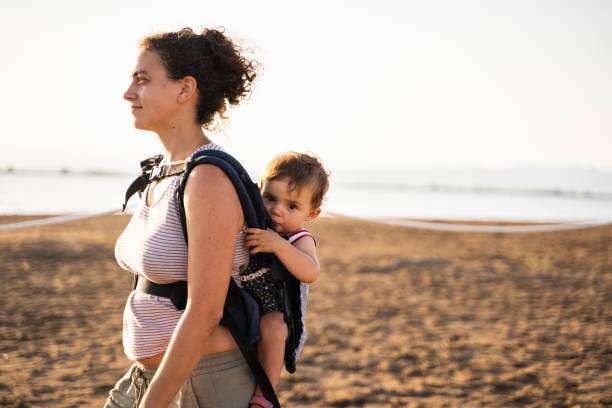
II. Concerns about operational complexity
Some parents believe that baby carriers are complicated to operate, requiring multiple adjustments to the shoulder straps, waistband, and buckles, which may lead to prolonged wearing time. This concern is particularly prominent among new parents, especially when the child is crying or when they are in a hurry, as the complexity of operation is amplified, thus creating psychological stress.
In fact, carriers are designed to allow parents to quickly and safely put them on. By pre-adjusting the shoulder straps and waistband length, mastering the fastening sequence, and familiarizing themselves with the baby carrier’s functions, parents can transform complex operations into familiar actions, significantly reducing dressing time. Real-world testing shows that after mastering the techniques, dressing time can be reduced to ten to twenty seconds, almost half the time of initial attempts. This increased efficiency not only alleviates the psychological burden on parents but also enhances the practicality of baby carriers in daily childcare.
III. Children’s maladaptive behaviors
In the initial stages of using a baby carrier, babies may squirm, cry, or refuse to get in. This behavior often causes anxiety for parents, who may doubt whether the carrier is suitable for their child or even have the misconception that the “equipment is unsuitable.” In reality, infant resistance often stems from the adaptation period to the new environment and unfamiliarity with the feel of the carrier against their body.
By using a gradual approach, children can slowly adapt to carriers. For example, start with short periods of use at home to let the child get used to the feel of the carrier against their body, gradually increasing the usage time. Simultaneously, use gentle reassurance and physical contact to help the child build a sense of security. Adaptation training not only alleviates discomfort for the child but also allows parents to use the carrier more calmly, reducing anxiety caused by the child’s resistance. Through this method, parents and children can adapt to baby carrier use together, achieving efficient and safe parent-child interaction.

IV. Anxiety about prices and inputs
High-quality baby carriers are expensive, while the market offers a large selection of low-priced options , often causing parents anxiety when making a purchase. On one hand, they worry about the financial burden of expensive carriers; on the other hand, they worry about the safety and comfort of cheaper carriers. This price anxiety often makes parents hesitate during the purchase process, and may even delay the time when to use the carrier.
In reality, from a long-term use and safety perspective, investing in a high-quality, fully functional baby carrier is often more cost-effective. High-quality carriers not only have a long lifespan but also feature scientifically designed weight-bearing capacity and comfort, allowing them to accompany a child through multiple stages of growth. Therefore, the long-term cost is lower than the cumulative expenditure of repeatedly purchasing cheaper carriers. By rationally analyzing the relationship between cost and function, parents can effectively alleviate price anxiety and achieve a balance between economic efficiency and practical benefits.
V. Psychological pressure related to use in public places
a baby carrier in public , some parents experience psychological pressure due to social evaluation or sensitivity to others’ opinions, worrying about whether their choice of baby carrier is appropriate or in line with “modern parenting trends.” This psychological pressure can make parents feel less natural when using the baby carrier , and may even slow down the process, thus affecting parenting efficiency.
The way to cope with this anxiety is to build self-confidence and understand that the essential function of a baby carrier is safety, comfort, and convenience, rather than meeting societal expectations. By skillfully using and scientifically selecting a baby carrier that suits both themselves and their child, parents can use baby carriers naturally in public, focusing their attention on the child’s safety and comfort, thereby reducing psychological burden and improving parenting efficiency.
VI. Confusion about multifunctional adaptation
Modern baby carriers offer a wide range of functions, such as switchable front-carry, back-carry, and side-carry modes, different adjustable shoulder and waist straps, and adjustable seat height and angle. Parents may feel confused when faced with these features, worrying that improper operation could affect their child’s safety and comfort, thus increasing their anxiety.
The solution to this confusion is to gradually familiarize yourself with the operation of each function and practice repeatedly at home to form operating habits. Once you master the multi-functional usage skills, parents can quickly switch between carrier modes according to different scenarios, improving baby-carrying efficiency. The multi-functional design is no longer a burden, but an effective tool to enhance parenting convenience, thus completely overturning parents’ anxieties about using a baby carrier .

VII. Concerns about long-term durability and maintenance
When purchasing baby carriers, parents also consider their durability and ease of cleaning and maintenance. Concerns about easily worn materials, damaged buckles, or difficult cleaning can increase their anxiety, causing hesitation in daily use and impacting the user experience. This anxiety about long-term durability often leaves parents struggling to choose a baby carrier , causing them to miss out on the convenience of scientifically sound parenting tools.
The solution is to choose a baby carrier that is quality certified, made of environmentally friendly materials, and easy to clean, while referring to the manufacturer’s maintenance guidelines for daily upkeep. High-quality baby carriers are generally superior to lower-priced products in terms of durability and ease of maintenance, maintaining stable performance and comfort over long-term use. Through scientific selection and standardized maintenance, parents can eliminate durability anxiety and truly integrate baby carriers into their daily childcare routine, achieving an efficient and worry-free parenting experience.
Conclusion
By analyzing seven reasons for resistance to baby carrier use, we can clearly see that parents’ anxiety about baby carriers largely stems from safety concerns, operational complexity, child’s unfamiliarity, price worries, psychological pressure in public places, confusion about multiple functions, and concerns about long-term durability. However, modern baby carriers, through scientific design, ergonomics, optimized materials, and multifunctional integration, can completely resolve these anxieties. Through skillful operation, gradual child adaptation training, rational selection, and scientific maintenance, parents can completely overturn their previous anxieties about baby carriers, making them a powerful tool for improving parenting efficiency and enhancing parent-child interaction.
a baby carrier lies not only in its portability but also in its positive psychological and behavioral impact. By understanding the seven reasons for resistance to baby carrier use and taking effective countermeasures, parents can confidently address parenting challenges, transforming the parenting experience from one of tension and anxiety into one of efficiency, comfort, and enjoyment. Using baby carriers scientifically frees parents from equipment anxiety, making the process of carrying the baby smooth and full of parent-child fun, truly achieving efficient and intelligent modern parenting.