
For new parents, how to properly use a baby carrier , especially choosing the right holding position, is often a hot topic. Some worry about whether the baby carrier is wide enough? Will certain holding positions affect the baby’s hip development? In fact, as long as the baby’s airway is clear and their legs are naturally apart rather than clamped, all holding positions are safe. The World Health Organization (WHO) recommends changing positions every hour for babies under one year old to ensure healthy development. This article will provide an in-depth understanding of three common baby carrier holding positions: facing inward, facing forward, carried on the back, and M-shaped, to provide greater peace of mind during your parenting journey.
Inward-facing: The best holding position for the first few months
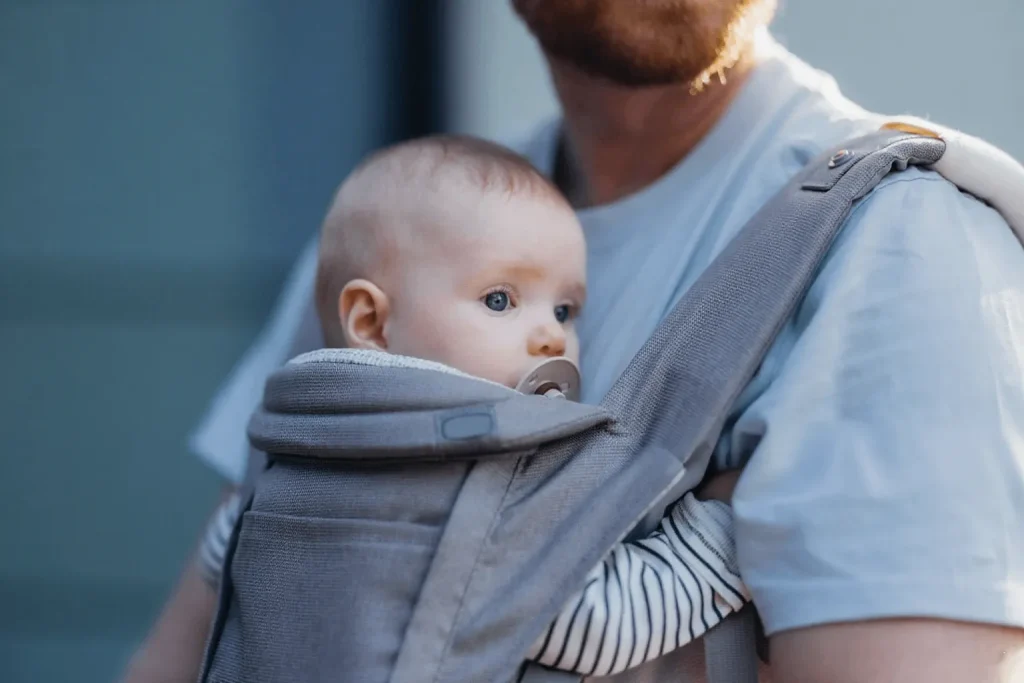
In the first few months of life, babies need closeness and security more than anything else. Their heads make up about a quarter of their body weight, and their neck muscles are still developing, making them unable to support their heads for long periods. Therefore, an inward-facing hold is ideal for the first five months.
Even after five months, many parents still prefer their baby to face inwards, and that’s perfectly fine. Our baby carrier is designed specifically for newborns and provides good head support and a natural leg position without the need for additional inserts.
Facing Forward: The First Step in Exploring the World
Around five months, the baby’s neck is fully developed and can support its head. Some babies can even sit up independently. At this time, the baby is full of curiosity about the world around him, and the forward-facing holding position is just right.
Facing forward not only satisfies the baby’s desire to explore, but also allows parents to better observe the baby’s reactions during interaction. It should be noted that facing outward will slightly increase the burden on the shoulders due to the baby’s weight, so it is necessary to flexibly adjust the position according to time and comfort.
Carrying on your back: a comfortable long-term option
When your baby is 12 months old, you can try carrying your baby on your back. As your baby grows in weight, this position will distribute the weight more evenly across your shoulders and back, reducing the pressure of carrying your baby from the front.
Carrying it on your back is more suitable for long-term use, such as when walking or traveling. For parents, this method is very similar to carrying a backpack, which is comfortable and labor-saving.
M-type and other holding positions
In addition to the three main positions, the M-position is also a common baby carrier holding position. The M-position positions the baby’s knees higher than their hips, creating a natural squatting position. This is easily achieved by placing the baby’s hips deeply into the carrier and raising their knees.
Similar positions include the frog hold and the physio hold. The frog hold places the knees higher, while the physio hold places the legs abducted and flexed 30 degrees. As long as parents regularly vary these positions, they are beneficial to the baby’s development.
Baby growth stages and baby carrier selection
Babies experience rapid growth in their first year:
0-3 months : The head is large and requires strong head support → It is recommended to face inward.
3-5 months : Head control gradually improves, but still requires support → Continue to face inward.
6-12 months : The head proportions are more coordinated and the baby can try to face forward to satisfy the desire to explore.
Over 12 months : Starts to stand and walk, and carrying the baby on your back becomes a more comfortable option.
24 months : The body proportions tend to be balanced and the baby can be flexibly switched between front and back carrying.
Our baby carriers are designed with these developmental milestones in mind, offering wide leg support and multi-level head protection to ensure your baby always feels natural and safe.

Summarize
a baby carrier lies in its flexibility: from inward-facing intimacy to forward-facing exploration to the comfort of carrying on your back, each position has its own stage of application and advantages. As long as you pay attention to your baby’s breathing and leg position, and change the holding position regularly, the baby carrier will become a valuable partner for you and your baby as you grow together.
Want to learn more about the different baby carrier models ? Click on our baby carrier comparison chart to find the best one for you and your baby.
FAQ
Q1: Will
a baby carrier affect the baby’s hip joints? No. As long as the baby’s legs are naturally apart and not clamped, a baby carrier is safe.
Q2: Can newborns use a baby carrier ?
Yes. Our carriers can be used from birth without the need for additional protective padding.
Q3: How often does the baby need to be held differently?
The World Health Organization recommends changing the holding position of babies under one year old every hour to promote healthy development.