
In the world of parenting, a baby carrier is both a tool to free up your hands and a way to strengthen the parent-child bond. Many parents enjoy holding their babies close to their chest or back, feeling their soft weight and feeling the synchronization of their breathing. However, beneath this tender surface, baby carrier parenting actually plays a profound role in the baby’s physical development. From the natural curve of the spine to hip joint stability and core muscle activation, different ways of using a baby carrier can influence a baby’s future posture and motor skills.
I. Spine: The Key to Development from C-shape to S-shape
A newborn’s spine has a natural C-shaped curve, a continuation of their curled-up position in the womb. It’s only until the baby can lift their head, sit, and walk that the spine gradually develops into an adult-like S-shaped structure. This transition is very delicate, requiring a balance between support and gravity. The baby carrier plays a dual role in this process: it can be both a supporter and a disruptor. An ideal carrier should allow the baby’s back to curve naturally, rather than forcibly straightening it. When the carrier is too stiff or the baby is suspended vertically, the spine bears asymmetrical pressure in its still-developing state. This “lifting” support can lead to back muscle tension and even affect the natural formation of the lumbar spine.
Conversely, baby carriers that conform to the baby’s body and allow the back to curve provide more physiological support. Especially in front-carrying and chest-hugging carriers, the parents’ bodies themselves become an extension support surface for the baby’s spine, allowing the baby to gradually exercise their neck and back muscles in a safe curve.
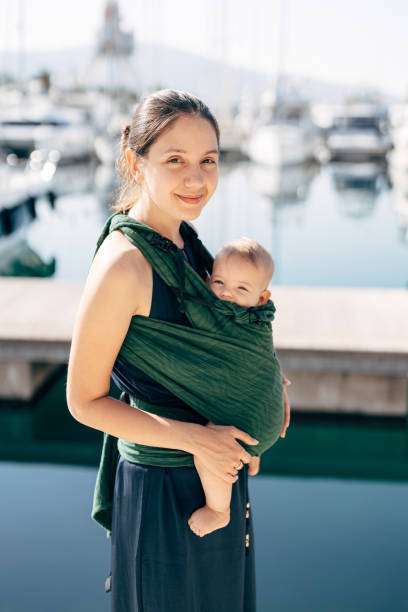
II. Hip joint: The most easily overlooked part of growth
Equally important as the spine is the baby’s hip joint. At birth, the bones of the hip joint are not yet fully ossified; the joint socket is shallow and has a large range of motion, requiring stable and symmetrical support to develop into the normal position.
Incorrect baby carrier techniques—especially the dangling position that causes the legs to dangle and concentrates the weight on the hips—can increase the risk of hip dislocation or dysplasia. This position, common in some traditional baby carriers or simple cloth straps, may seem convenient, but it puts excessive strain on the developing pelvic structure.
Pediatric orthopedic specialists generally recommend the “M-shaped legs” or “frog legs” posture: both knees are slightly higher than the hips, the thighs are turned outwards at about 60-120 degrees, and the buttocks are slightly lower, forming a natural sitting posture. This posture allows the femoral head to be firmly embedded in the acetabulum, promoting normal ossification.
A well-designed baby carrier will create a broad, supportive surface around the baby’s thighs, distributing the weight across the thighs and buttocks, rather than concentrating it in the groin area. For parents, the most intuitive criterion when choosing a baby carrier is that the baby’s knees should be higher than their hips. This seemingly simple point determines the healthy foundation for hip joint development.
III. Core Muscles: “Invisible Training” in the Suspension Belt
The core muscles are key to supporting body posture and movement coordination, including the abdominal muscles, back muscles, and deep stabilizing muscles. Although an infant’s core strength is not yet fully developed, their body is not entirely passive when being carried.
When parents walk, turn around, or bend over, babies constantly adjust their center of gravity to maintain balance. This subtle postural control is actually a natural form of core training. Especially in a baby carrier that fits snugly against the body, babies can sense their parents’ pace and breathing rhythm, responding with tiny muscle contractions. This dynamic stability training helps promote postural control, balance, and body coordination.
However, this training must be done with proper support. If the carrier is loose or the baby is positioned incorrectly, the baby will be forced to rely on one side of their muscles to maintain balance, which may lead to uneven muscle development over time. The ideal situation for baby carrier parenting is to ensure that the baby is securely supported while still having a little freedom of movement.
IV. Posture and Time Control During the Use of Baby Carriers
The benefits of baby carriers do not mean they can be used continuously for extended periods. Even with ergonomic designs, attention should be paid to usage time and posture adjustments. It is generally recommended that each use not exceed two hours, especially during the newborn stage, when babies need to be laid flat and stretched regularly to avoid prolonged pressure on the spine and hips.
The baby carrier method should be adjusted accordingly for babies of different ages:
Newborn stage: Use a baby carrier with head and neck support to maintain a C-shaped back and M-shaped legs posture.
The stage where the baby can lift their head (about 3-4 months): The baby can be slightly upright but still needs to stay close to the parents’ body.
After the baby can sit up (around 6 months): The baby can face outwards in a baby carrier, but not for too long, to avoid putting pressure on the waist and hips.
Parents’ posture is equally important. Relaxed shoulders, an upright back, and a slightly tucked-in abdomen prevent the weight from concentrating on the lower back and improve overall stability. Baby carriers not only affect infant development but also test parents’ posture control.

V. Intimacy and Development: The Dual Significance of Baby Carriers
The benefits of baby carriers go beyond mere convenience. Psychological research has found that babies carried close to the body are more emotionally stable and have a stronger sense of security in their environment. The physical closeness allows them to hear familiar heartbeats, breathing, and footsteps; this sensory synchronization has a positive effect on early neurological development.
In this process, physical and psychological development are intertwined. While being carried, infants not only receive physical support but also develop a sense of body boundaries and trust. For parents, baby carriers allow them to more directly perceive their baby’s state, adjust their pace, breathing, and posture, and achieve silent interaction. This “physical dialogue” is the gentlest part of developmental support.
VI. The bottom line for scientific use: support, symmetry, and fit.
Regardless of the type of baby carrier, the core principles remain unchanged: comprehensive support, symmetry, and a proper fit.
Support means that the baby’s body is evenly supported, avoiding single-point pressure;
symmetry ensures that the weight is evenly distributed on the left and right hip joints and spine, preventing lateral tilting.
And a proper fit means that the carrier wraps around the baby like a second skin, neither too loose nor too tight.
When using a baby carrier, parents should observe their baby’s reactions: if the baby’s legs can move freely and the head rests naturally on the chest or shoulder without tension or tilting backward, the position is suitable. If the baby cries, squirms, or has difficulty breathing, the carrier should be adjusted or removed immediately.
Conclusion
A baby carrier is not a restriction but an aid. They help babies explore the world in their parents’ arms and help their bodies learn balance with gentle support. Understanding the relationship between baby carriers and physical development is not about making parents afraid to use them, but about enabling them to use them more scientifically and confidently.
From spine to core, from posture to psychology, the significance of baby carrier parenting goes far beyond convenience. It is a form of physical education that allows growth to occur in the most natural rhythm from the moment a child is picked up.