7 noise tests conducted on baby carrier: Vibration and noise pose alarming risks

Baby carrier have become an indispensable tool for modern families with young children. They not only free parents’ hands when holding their babies but also keep babies safe and comfortable. However, many parents focus primarily on the softness of the material, shoulder and waist support, and baby posture when choosing a baby carrier, rarely realizing the significant impact of vibration and noise in actual use. Even minor vibrations or noise generated by material friction during prolonged wear can potentially interfere with a baby’s sleep, mood, and even physical development—issues that are often imperceptible in short-term use.
To fully understand the baby carrier’s performance in terms of quietness, we conducted seven key tests, simulating real-world usage scenarios for babies and parents, ranging from daily walking, brisk walking, and climbing stairs to everyday household chores and outdoor activities. These tests not only examined the noise levels of the baby carrier’s materials and structure under friction or vibration but also analyzed the impact of different actions on the baby’s mood and comfort, thus revealing the potential harm caused by vibration and noise.
I. Daily Walking Test: Potential Interference from Minor Vibrations
In normal walking scenarios, each step taken by parents can cause the baby to sway slightly. A high-quality baby carrier, through its appropriately wide shoulder straps, supportive waistband, and backrest, distributes the baby’s weight evenly, minimizing unwanted vibrations during walking. Testing has shown that high-quality carriers are virtually noiseless during such activities, ensuring the baby’s stability and calm.
However, low-quality baby carriers can produce slight noise during everyday walking due to friction between the shoulder straps and back panel or contact between the back panel and the baby’s clothing. Although minor, this noise can still be disruptive to a baby’s concentration or sleep. Accumulated vibrations can also cause slight shifts in the baby’s posture, gradually concentrating pressure on the shoulders and waist and causing mild fatigue for parents. This test demonstrates that even in the most basic walking scenarios, the quietness and vibration control of the carrier are crucial indicators of a comfortable experience.
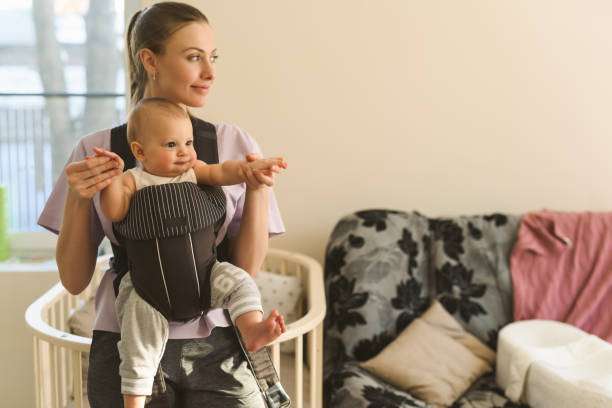
II. Rapid Movement Test: Vibration Amplification Effect
When parents walk briskly or run lightly, the inertia of their bodies increases the amplitude of vibration experienced by the baby. Tests show that high-quality baby carriers effectively cushion vibrations through their 3D back panel and shoulder strap structure, producing minimal vibration and almost no noise, allowing the baby to maintain a stable posture without leaning forward or wobbling.
Low-quality baby carriers perform poorly in this scenario. The friction between the shoulder straps and back panel produces noticeable noise, which may irritate the baby due to slight shaking, increase the strain on the parents’ shoulders and back, and make them more prone to fatigue during prolonged wear. The fast-movement test reveals the requirements for quietness and comfort in carrier design under dynamic conditions; insufficient vibration control may affect the baby’s mood and the parents’ user experience.
III. Staircase Test: Cumulative Effects of Vertical Vibration
Going up and down stairs is one of the activities that most tests a baby carrier’s support and noise reduction performance. Each step produces noticeable vertical vibration, and if the carrier doesn’t provide enough cushioning, the baby’s buttocks and back will be subjected to repeated vibrations, resulting in a slight impact sensation.
Tests revealed that high-quality baby carriers effectively disperse impact when going up and down stairs, maintaining the baby’s sitting posture with minimal vibration transmission and effective noise suppression. Low-quality carriers, on the other hand, are noticeably noisy during stair climbing, potentially causing the baby to lean forward slightly or even startle. Prolonged use may lead to emotional instability or even mild anxiety in the baby. The stair climbing test highlights the importance of a baby carrier’s vertical vibration cushioning and quiet design.
IV. Household chores performance test: micro-motion frequency and noise sensitivity
During daily household chores, parents frequently bend over, rotate, and stretch, causing continuous micro-vibrations in the baby carrier. Even seemingly minor movements, when repeated frequently, can accumulate and affect the baby. A high-quality baby carrier features shoulder straps and a backrest designed to stabilize the baby’s posture, with low friction noise, minimizing disturbance to the baby and allowing parents greater freedom of movement.
Low-quality baby carriers are prone to making friction noises in such scenarios, which may cause the baby to become slightly irritable or try to adjust their position. The cumulative vibrations and noise from long-term household chores reduce comfort and increase the frequency of carrier adjustments for parents, impacting daily childcare efficiency. Household chores tests show that quiet operation and shock absorption directly affect the actual usability of the carrier in high-activity environments.

V. Outdoor Activity Test: The Combined Impact of Wind, Ground, and Baby Carrier Interaction
During outdoor activities, parents may walk at different paces, and the terrain can be complex, with wind and uneven surfaces potentially causing more vibration in the baby carrier. A high-quality carrier maintains a stable and snug fit under these conditions, with good noise control, allowing the baby to sit naturally and remain calm. The elasticity of the shoulder straps and the back panel structure absorb irregular vibrations, ensuring comfort for the baby even after extended wear.
Low-quality baby carriers exhibit significant shortcomings in outdoor environments. The combined effects of friction noise and slight shaking can easily startle the baby, increase strain on parents’ shoulders and backs, and lead to fatigue and discomfort during prolonged use. Outdoor testing highlights the importance of a carrier’s shock resistance and quiet operation in complex environments and also validates the crucial role of materials and structure in ensuring a comfortable experience.
VI. Shaking and Rotation Test: The Challenge of Multi-directional Vibration
When parents hold and rotate or gently rock their baby, vibrations from multiple directions can overlap, making testing more demanding. High-quality baby carriers utilize a 3D design with shoulder straps, a waistband, and a back panel to provide multi-point support for the baby’s body, effectively cushioning vibrations, minimizing friction noise, and maintaining a stable sitting posture, making the baby less prone to startle.
Low-quality baby carriers, due to their simple structure or obvious material friction, are prone to causing babies to lean forward or sway from side to side during multi-directional vibrations. This also amplifies noise, potentially causing mild fright or restlessness in the baby. Parents need to adjust the baby’s position frequently, resulting in a decreased wearing experience over extended periods. Shaking tests show that multi-directional shock resistance and quiet operation are key indicators of the overall design maturity of baby carriers.

VII. Long-term wear test: cumulative vibration and noise effects
Prolonged wear can amplify the cumulative effect of minute vibrations and noise generated by a baby carrier during daily activities. A high-quality baby carrier can remain stable and comfortable even after two to five hours of continuous wear, allowing the baby to maintain a natural posture, with friction noise that is almost imperceptible, and providing parents with a reasonable distribution of pressure on their shoulders and waist, preventing significant fatigue.
Low-quality baby carriers, when worn for extended periods, experience shoulder strap slippage and slight folding of the back panel, leading to accumulated vibrations and frequent friction noise. This can cause babies to become irritable and attempt to adjust their posture while significantly increasing pressure on parents’ shoulders and back, impacting the daily user experience. Long-term wear tests have fully demonstrated the crucial role of noise reduction and shock absorption in the comfort and practicality of baby carriers.
in conclusion
Seven noise reduction tests clearly demonstrate that differences in vibration and noise control in baby carriers directly impact a baby’s comfort and the parent’s experience. High-quality baby carriers achieve shock absorption and quiet operation through proper pressure distribution, three-dimensional support, and premium materials, ensuring comfort and safety even after extended wear. Low-quality baby carriers are prone to vibration and noise during daily walking, housework, climbing stairs, and outdoor environments, affecting a baby’s mood and postural stability and significantly reducing the comfort of prolonged wear.
When choosing a baby carrier, it’s important to consider not only the material and shoulder/waist support but also its noise reduction and shock absorption. This not only affects comfort but also the quality of parent-child interaction, parenting efficiency, and the baby’s sense of security. Seven noise reduction tests reveal the potential hazards of vibration and noise, providing parents with a scientific reference for selecting and using a baby carrier.